Deep Work
Start a focused study timer and record the time you spent studying.
I studied neuroscience and biophysics at UT Austin. I'm pre-med, and I prepared for the MCAT while working full-time.
Hours logged toward the MCAT
PROJECT 01
The books I read influenced the way I thought about learning, focus, and productivity. I gradually developed my own seven principles and tried to turn them into a system I could actually follow.
When I was studying for the MCAT, I would start a timer for Deep Work, record my hours in a calendar, and come back to a few recurring commitments every day. I kept track of practice exams and made time to recharge, too. These things worked for me, but they were all in different places.
The idea behind MCAT Study Buddy is to bring those parts together. I wanted something simple that would help me spend less time organizing my studying and more time doing it.
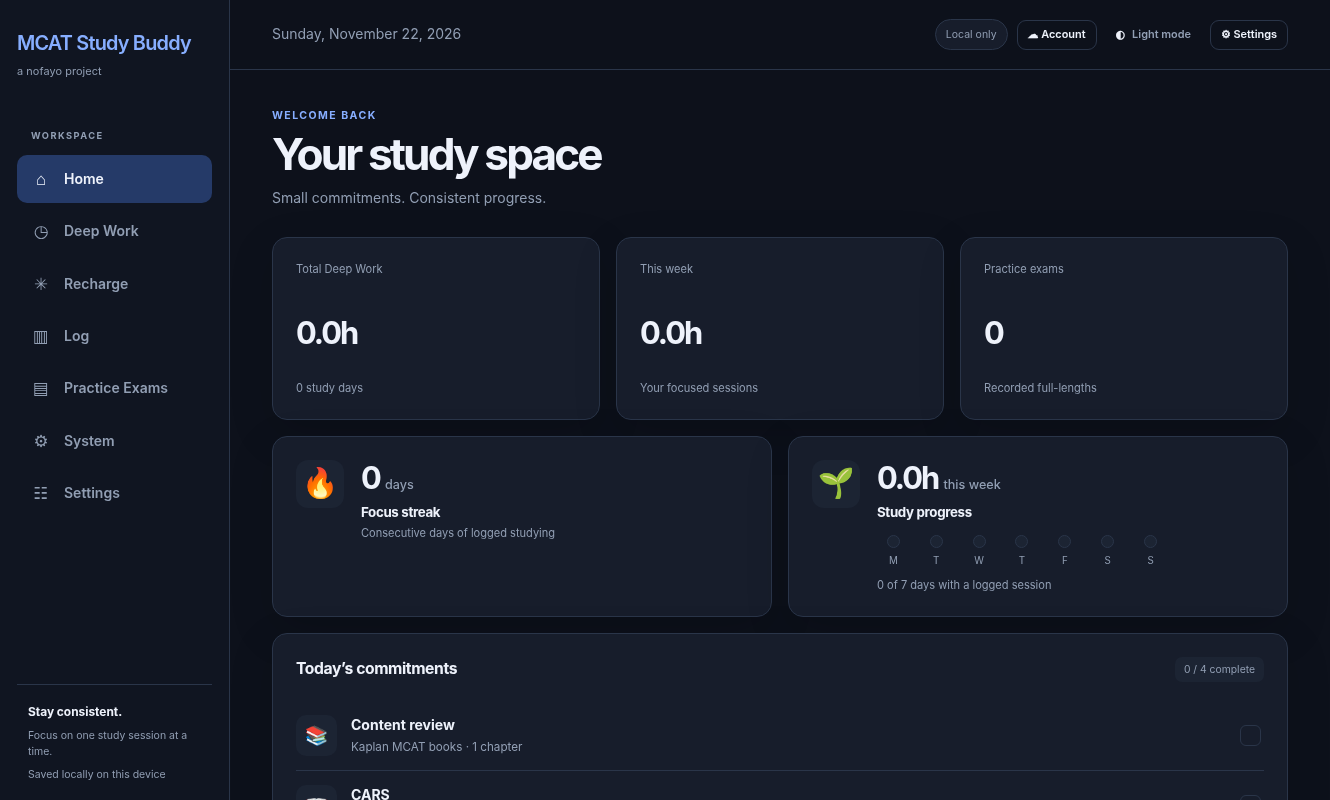
Start a focused study timer and record the time you spent studying.
Look back on study sessions and see your progress over time.
Keep the things you want to practice every day in one place.
Schedule full-lengths, record section scores, and follow your progress.
Make room for breaks and the activities that help you come back.
Set your MCAT date and adjust your routines to fit how you study.

Your thoughts don't always reflect reality. If you get stuck worrying about your score or whether you're doing enough, you can notice the thought without following it. Then return to what's in front of you.
I kept coming back to one idea: systems matter more than goals. For the MCAT, that meant making practice, review, and Deep Work easy to repeat instead of constantly thinking about the score.
The important distinction for me was depth versus busyness. I started tracking focused sessions because I wanted to know how much time I was actually thinking, not just how long I sat at a desk.
Expertise is developed by practicing at the edge of your ability and getting feedback. For the MCAT, that meant doing questions I struggled with, reviewing the reasoning, and using mistakes to guide the next session.
I used to associate serious work with pressure. This helped me see that curiosity, enjoyment, and feeling good can make ambitious work more sustainable.
This made me think about the principles behind my habits, not just the habits themselves. “Sharpen the saw” was especially important: your capacity to work depends on taking care of your life outside work.
Do fewer things, work at a natural pace, and obsess over quality. This gave me permission to think in months instead of days, and to stop confusing constant urgency with progress.
This challenged me to stop treating discomfort as a reason to quit. The part I carried into studying was to show up for difficult work, even when I didn’t feel like it.
Not everything on a to-do list matters equally. I learned to find the one thing that would make the biggest difference today and protect time for it.
You will never get everything done, and that’s okay. This made me more comfortable choosing a few things that really matter instead of trying to squeeze something useful out of every minute.
What stayed with me was the idea of competing against yourself and doing the reps consistently. I’ve also learned that pushing hard works best when I leave room to recover.
Work and rest are not opposites. I started treating breaks, sleep, and time away from a problem as part of the creative and learning process.
Effort and perseverance are skills worth developing, not just personality traits. It reinforced my belief that showing up repeatedly matters more than the occasional perfect study day.
Learning that feels easy is not always learning that lasts. Retrieval, spacing, and mixing different problems helped me rethink studying as something you do, not something you reread.
I connected with the value of sustained effort and taking responsibility for your work. It reminded me that progress requires a willingness to attempt things that are genuinely difficult.
Make the behavior small enough to begin and connect it to a reliable cue. The lesson for me was to lower the activation energy instead of depending on motivation.
Excellence feels more meaningful when it aligns with your values. I was struck by the idea that what you discover while pursuing something difficult can matter more than the result itself.
I liked the idea that growth is something you keep choosing, even when no one is watching. It encouraged me to keep working through setbacks rather than wait until I felt completely ready.
I became more aware of how easily we adopt beliefs and expectations without questioning them. That pushed me to challenge unhelpful assumptions instead of treating every thought as truth.
I learned that understanding another person is more important than trying to impress them. Genuine interest, listening, and honest appreciation changed how I think about teaching and working with people.
Your current ability does not define where you can end up. The more useful question is whether you are learning, putting in the effort, and getting better.
Choose a daily highlight, protect it from distractions, and make room for energy and enjoyment. I used that idea to organize days around one important study task.
Instead of trying to design a perfect plan, start a small experiment and learn from the result. That fits the way I like to approach research, studying, and personal systems.
Difficult days are part of any worthwhile pursuit. I learned to stop waiting for things to feel easy before getting to work, and to put my effort toward what I can control.
The questions I wrote down were about betting on yourself and what you are willing to commit to. It made me reflect on the difference between healthy ambition and becoming consumed by it.
Confidence comes from preparation, but performance also requires being present. Gratitude, constructive self-talk, and bouncing back matter when the stakes feel high.
Your mind is better for thinking than for holding every obligation and useful idea. This influenced the way I used Notion to capture what mattered and find it again when I needed it.
Exercise is not separate from how well you think and feel. This strengthened my commitment to movement as part of a sustainable study routine.
If you want to get better at a task, practice the task itself. That pushed me toward timed passages, active recall, and studying in conditions closer to the real MCAT.
Build rare and useful skills through deliberate practice; passion can develop as you become better at your craft. This influenced how I think about research, medicine, and choosing meaningful work.
Sleep shapes learning, memory, and your ability to function the next day. I learned to think of a consistent sleep routine as a foundation, not time stolen from studying.
A full life needs more than a professional goal. I connected with the importance of purpose, friendships, movement, and enjoying the work in front of you.
Toughness is not forcing yourself through everything. It is learning the skills to meet difficulty with clarity, flexibility, and composure.
Unfinished commitments use up attention. Writing down specific next actions and putting time-sensitive work in the calendar helped me stop trying to keep the whole plan in my head.
Stress alone does not produce growth; adaptation also requires rest. That helped me think about studying more like training, with deliberate periods of work and recovery.
The most useful part for me was taking ownership of the work and refusing to settle for autopilot. It also reinforced the need to direct intensity toward a few things instead of everything.
Ideas only matter when you put them into practice. Short planning cycles, clear commitments, and regular review gave me a useful alternative to vague long-term goals.
I was drawn to the idea of developing specific skills that feel natural to you and creating things with leverage. It also reminded me that compounding applies beyond money: skills, knowledge, and relationships grow over time.
The idea that happiness must follow success has things backward. I started taking the possibility seriously that enjoying the process could help me do better work in the first place.
I kept coming back to the distinction between my thoughts and who I am. Mindfulness and questioning inherited expectations helped me think about living more deliberately.
Worrying can become a habit that feels useful even when it is not. I found it helpful to get curious about that loop and practice noticing it instead of automatically following it.